Blogroll

วันอังคารที่ 20 สิงหาคม พ.ศ. 2556

สัญญาณอันตราย : นักวิเคราะห์ต่างชาติชี้ศก.ไทยเข้าสู่ภาวะถดถอยแล้ว

สัญญาณอันตราย : นักวิเคราะห์ต่างชาติชี้ศก.ไทย
เข้าสู่ภาวะถดถอยแล้ว 


สำนักข่าวบลูมเบิร์กรายงานเมื่อวันที่ 20 สิงหาคมว่า นายฮิเดกิ ฮายาชิ ผู้เชี่ยวชาญประจำศูนย์วิเคราะห์เศรษฐกิจของญี่ปุ่นระบุว่า ขณะนี้เศรษฐกิจไทยถือว่าได้เข้าสู่ภาวะเศรษฐกิจถดถอยเป็นครั้้งแรกในรอบปี 2009 หลังจากค่าเงินบาทของไทย ซึ่งเป็นประเทศเศรษฐกิจใหญ่อันดับสองของอาเซียน ได้อ่อนตัวต่ำสุดในรอบ 1 ปี และภาวะดังกล่าวจะส่งผลกระทบตลาดหุ้นไทยเจอภาวะหุ้นตก

รายงานระบุว่า ที่ผ่านมา ตัวเลขจีดีพีของไทยได้ตกลงอย่างไม่คาดฝัน โดยลดลง 0.3 เปอร์เซ็นต์ ในช่วงไตรมาสที่ผ่านมา และสภาพัฒนาการเศรษฐกิจและสังคมแห่งชาติ (สศช.) ได้ปรับลดการประเมินการทางเศรษฐกิจของไทยที่คาดว่าจะเติบโตที่ระดับ 4.2-5.2 เปอร์เซ็นต์ เหลือที่ระดับ 3.8-4.3 เปอร์เซ็นต์ ขณะที่นักวิเคราะห์ต่างชาติคาดว่า ธนาคารชาติของไทยจะคงอัตราดอกเบี้ยอยู่ที่ระดับ 2.5 เปอร์เซ็นต์


ขณะเดียวกัน ด้านหน่วยงานวิเคราะห์เศรษฐกิจ "BNP Paribas SA" ยังได้ปรับลดการคาดการณ์การเติบโตทางเศรษฐกิจของไทยจาก 4.5 เปอร์เซ็นต์ เหลือเพียง 3 เปอร์เซ็นต์ 

Resource from: 

วันศุกร์ที่ 16 สิงหาคม พ.ศ. 2556

16 Ausgust 2013 : Cairo Burning and 683 people killed!

16 Ausgust 2013 : Cairo Burning and 683 people killed!


วันพฤหัสบดีที่ 15 สิงหาคม พ.ศ. 2556

กรุงเทพเมืองน่าเที่ยว แต่ไม่น่าอยู่

กรุงเทพเมืองน่าเที่ยว แต่ไม่น่าอยู่

โดย   วีรพงษ์ รามากูร


เมื่อเดือนกรกฎาคมที่ผ่านมา ผู้ว่าฯกรุงเทพ มหานครได้เดินทางไปรับรางวัลกรุงเทพฯเป็นเมืองที่น่าท่องเที่ยวที่สุดในโลก จากนิตยสาร Travel and Leisure ที่มหานครนิวยอร์ก สหรัฐอเมริกา กรุงเทพมหานคร ได้รับรางวัล The World′s Best City Award 2013 ด้วยคะแนนสูงสุด 90.40 ตามมาด้วยเมืองอิสตันบูล ตุรกี 89.96 อันดับ 3 เมืองฟอเรนซ์ อิตาลี 69.84 อันดับ 4 เมืองเคปทาวน์ แอฟริกาใต้ 89.03 อันดับ 7 เมืองชาร์ลตัน เซาท์แคโรไลนา สหรัฐอเมริกา 88.65 อันดับ 8 เมืองบาร์เซโลนา สเปน 88.45 อันดับ 9 กรุงปารีส ฝรั่งเศส 88.35 และอันดับ 10 เมืองเชียงใหม่ ประเทศไทย ด้วยคะแนน 88.15

เป็นอันว่าเมืองที่น่าท่องเที่ยวมากที่สุดในโลก ประเทศไทยมีเมืองที่ติดอันดับสูงสุด 10 อันดับถึง 2 เมืองคือกรุงเทพมหานคร และนครเชียงใหม่

ผู้ว่าฯกรุงเทพมหานคร ได้แถลงว่าปี 2556 นี้ กรุงเทพมหานครได้รับรางวัลทางด้านการท่องเที่ยวหลายรางวัลคือ รางวัลเมืองท่องเที่ยวที่ดีที่สุดในโลกจากนิตยสาร Travel & Leisure รางวัลชนะเลิศสุดยอดจุดหมายปลายทางของโลกปลายปี 2556 รางวัล Traveller′s Choice Destination awards 2013 ของ มาสเตอร์การ์ด เวิลด์วายด์ "Master Card Worldwide" และรางวัลจุดหมายปลายทางที่นักท่องเที่ยวเลือกปี 2013 จากเว็บไซต์ "Trip Advisor" ซึ่งเป็นเว็บไซต์การท่องเที่ยวที่ใหญ่ที่สุดของโลก ที่ให้ลงคะแนนเลือกหนึ่งใน 25 เมืองที่นักท่องเที่ยวต้องการเดินทางไปมากที่สุดในโลก

นอกจากจะเป็นเมืองที่นักท่องเที่ยวได้ลงคะแนนให้เป็นเมืองที่น่าเที่ยว และน่าจะเป็นจุดหมายปลายทางที่ดีที่สุดในโลกแล้ว ถ้ามาดูกันเฉพาะในเอเชียด้วยกัน กรุงเทพมหานครก็ยังได้คะแนนเป็นเมืองน่าเที่ยวที่สุด ด้วยคะแนน 90.40 รองลงมาคือกรุงโตเกียว เชียงใหม่ เสียม ราฐ ฮ่องกง สิงคโปร์ นครเซี่ยงไฮ้ กรุงโซล และฮานอย ตามลำดับ

หลักเกณฑ์ที่พิจารณาให้คะแนนมีอยู่ทั้งหมด 6 ประการด้วยกันคือ 1.สถานที่ท่องเที่ยว ทัศนียภาพ ความสวยงามและความร่มรื่น 2.ศิลปวัฒนธรรมประเพณี 3.อาหารการกิน 4.แหล่งจับจ่ายใช้สอย 5.ความเป็นมิตรของผู้คน และ 6.ความคุ้มค่าของเงิน หรือความพึงพอใจที่ได้รับจากการจับจ่าย

เป็นที่น่ายินดีว่ากรุงเทพมหานครและนครเชียงใหม่ของเรา ได้รับความนิยมจากนักท่องเที่ยว ต้องถือว่าเป็นความสำเร็จของกรุงเทพมหานคร ที่มีนโยบายมุ่งส่งเสริมและพัฒนาการท่องเที่ยว ตามนโยบาย "กรุงเทพฯเมืองยิ้ม" หรือ "Bangkok Smile" และนโยบายหลักอื่นๆ อันได้แก่ วัฒนธรรมประเพณี อัธยาศัยไมตรีของผู้คน แม่น้ำเจ้าพระยา และลำคลองสายหลักต่างๆ อาหารไทย ตลาดสรรพสินค้า การแพทย์และสุขภาพแผนไทย ที่สำคัญที่สุด คือความคุ้มค่าของเงินที่นักท่องเที่ยวต้องจับจ่ายใช้สอยในกรุงเทพมหานคร ซึ่งก็สอดคล้องกับเกณฑ์ที่เขาตั้งในการให้คะแนน

เรื่องนี้เป็นเรื่องสำคัญ เพราะการท่องเที่ยวเป็นกิจการที่ประเทศไทยต้องถือว่าเป็นกิจการที่ได้รับความสำเร็จมากที่สุด ตั้งแต่เราได้เริ่มพัฒนาเศรษฐกิจของเรา ตั้งแต่แผนพัฒนาเศรษฐกิจและสังคม ฉบับที่ 1 เป็นกิจการที่ถูกกับนิสัยคนไทยมากที่สุด เพราะคนไทยชอบความสนุกสนานเฮฮา โอบอ้อมอารีต่อแขกเหรื่อ ไม่ต่อต้านคนต่างชาติ ใครเข้ามาก็ต้อนรับ เมืองไทยจึงมีคนหลายเชื้อชาติผสมผเสปนเปกัน จึงไม่น่าแปลกใจที่กรุงเทพฯและเชียงใหม่ ได้รับความนิยมอันดับต้นๆ ของโลกและของทวีปเอเชีย ในฐานะเมืองที่น่าเที่ยวและน่าไปมากที่สุด

เราคนไทยที่อยู่ที่กรุงเทพฯ หรือเชียงใหม่ คงไม่รู้สึกอะไร แต่คนไทยกลับนิยมไปเที่ยวญี่ปุ่นหรือปักกิ่ง เซี่ยงไฮ้ ลอนดอน ปารีส หรืออะไรเทือกนั้น เป็นจำนวนมาก แล้วก็ไม่ค่อยทราบว่าชาวโลกเขาชอบเมืองไทย โดยเฉพาะกรุงเทพฯ เชียงใหม่ ภูเก็ต สมุย ว่าเป็นเมืองที่น่าท่องเที่ยวน่าสนใจอย่างไร

มีอยู่ 3 เรื่องที่น่าห่วงในอนาคต ที่เราคงจะต้องเอาใจใส่ดูแล เพื่อให้บ้านเมืองของเรายังคงครองความเป็นเลิศในชาวนักท่องเที่ยวของโลก

เรื่องแรก ที่คิดว่ายังไม่ผ่านคือ ความสะอาดสอ้านของแม่น้ำเจ้าพระยา คลอง คู ทางระบายน้ำ ถ้าเทียบกับแม่น้ำอื่นๆ ของเมืองท่องเที่ยวของโลกแล้วยังห่างไกลกันมาก ของเรายังสกปรก มีขยะมูลฝอย ส่งกลิ่นรบกวนอย่างไม่น่าเชื่อ ยิ่ง คู คลอง ทางระบายน้ำในกรุงเทพมหานครด้วยแล้ว ต้องถือว่าคะแนนควรจะอยู่ในอันดับท้ายๆ ของนครใหญ่ๆ ของโลก เวลาฝนตกหนักๆ น้ำจากท้องร่องที่ใช้เป็นที่ระบายน้ำ จะเอ่อขึ้นมาจนถึงทางเท้า เป็นที่น่ารังเกียจ

คลองบางซื่อ ที่อยู่ใกล้ๆ บ้าน เมื่อเกิดมหาอุทกภัยเมื่อปลายปี 2554 เต็มไปด้วยขยะมูลฝอย ทหารที่ไปช่วยระบายน้ำพบที่นอน 6 หลังจมอยู่ในคลอง ทำให้การระบายน้ำเป็นไปอย่างทุลักทุเล

เคยไปประเทศจีน ที่เมืองกว่างโจว เมื่อ 20 ปีก่อน แม่น้ำไข่มุกหรือจูเจียง ก็มีลักษณะเน่าเหม็น เหมือนคลองแสนแสบ หรือแม่น้ำเจ้าพระยา แต่เดี๋ยวนี้น้ำใสสะอาดมองไม่ออกว่าเมื่อก่อนเป็นอย่างไร

คงอีกนานที่ระบบระบายน้ำเสียในกรุงเทพ มหานคร ทั้งฝั่งพระนครและฝั่งธนบุรี จะสามารถพัฒนาให้สะอาดสอ้านถูกสุขอนามัยได้ ตราบใดที่บ้านเรายังใช้ระบบส้วมซึมอยู่ ครั้นจะเปลี่ยนเป็นระบบท่อระบบอุโมงค์ก็คงจะทำได้ยากเพราะเราไม่มีผังเมือง ถ้าจะทำก็คงโกลาหลและมีราคาแพง

เรื่องที่สอง
 คือเรื่องมลพิษทางอากาศ ปัญหามลพิษทางอากาศมีความสาหัสพอๆ กับเรื่องน้ำ เคยได้ยินว่าเมื่อ 20 ปีก่อน ปริมาณตะกั่วในอากาศในกรุงเทพฯมีสูงกว่า 4 เท่าของระดับมาตรฐาน จนต้องประกาศเลิกใช้น้ำมัน ออกเทนสูงซึ่งมีตะกั่วเป็นส่วนผสม แต่มลพิษทางอากาศที่เกิดจากไอเสียรถยนต์ก็ยังเป็นปัญหาสำคัญอยู่ เพราะการใช้รถยนต์ต่อคนต่อระยะทางของประชากรในกรุงเทพฯมีสูง เพราะการขาดแคลนระบบขนส่งมวลชนในกรุงเทพฯ

ปัญหาใหม่ที่กรุงเทพมหานครประกาศก็คือ ฝุ่น มีระดับสูงกว่ามาตรฐาน รวมทั้งได้ประกาศพื้นที่ในกรุงเทพมหานครที่มีความเสี่ยงจากมลพิษจากฝุ่น ในจำนวน 33 เขตของกรุงเทพฯ มีอยู่ 18 เขตที่ปริมาณฝุ่นมีระดับสูงกว่าระดับอันตราย ได้แก่ ดุสิต จตุจักร ปทุมวัน ราชเทวี สาทร ตลิ่งชัน บางกะปิ บางเขน ดอนเมือง ห้วยขวาง ยานนาวา บางรัก พญาไท ลาดกระบัง ธนบุรี ทวีวัฒนา และบางนา เป็นต้น

นอกจากปัญหาเรื่องน้ำ เรื่องอากาศ ปัญหาเรื่องเสียงก็เป็นปัญหาสำคัญ สำหรับคนกรุงเทพฯ ซึ่งมีระดับสูงกว่ามาตรฐานที่ปลอดภัย

พื้นที่สีเขียวของกรุงเทพฯ สำหรับประชากรหนาแน่นกลับมีน้อยกว่ามาตรฐานเป็นอันมาก สวนสาธารณะซึ่งเป็นสิ่งจำเป็นสำหรับเมืองใหญ่ กรุงเทพฯก็มีพื้นที่ที่กันไว้เป็นสวนสาธารณะน้อยที่สุดในโลกแห่งหนึ่ง

สำหรับอาหารการกินก็เป็นที่ยอมรับ อาหารไทยที่กรุงเทพฯนั้นเป็นอาหารไทยที่เป็นไทยแท้กว่าที่อื่นทั่วโลก นอกจากนั้น ร้านอาหารนานาชาติ ไม่ว่าจะเป็นอาหารจีน ญี่ปุ่น ฝรั่งเศส อิตาเลียน อินเดีย ตะวันออกกลาง และอื่นๆ ร้านอาหารที่เปิดที่กรุงเทพฯก็ไม่แพ้ที่ใดในโลก มีร้านอาหารเปิดบริการ 24 ชั่วโมง กรุงเทพฯเป็นเมืองที่ไม่รู้จักหลับ นักท่องเที่ยวหาความสุขได้ตลอดวันตลอดคืน

แต่คะแนนที่ให้กับอัธยาศัยไมตรี ความโอบอ้อมอารี ตามนโยบายกรุงเทพฯเมืองยิ้มหรือ "Bangkok Smile Policy" นั้นยังสงสัย การที่นักท่องเที่ยวให้คะแนนในหมวดนี้ อาจจะเป็นไปได้ที่คนกรุงเทพฯที่นักท่องเที่ยวพบเห็นและสัมผัสด้วย คงเป็นผู้คนที่เกี่ยวข้องกับการให้บริการ ตั้งแต่สนามบิน ไปจนถึงโรงแรมและแหล่งท่องเที่ยว พนักงานห้างสรรพสินค้า ร้านอาหาร รวมทั้งผู้คนทั่วไปตามถนนหนทาง

แต่ถ้าติดตามข่าวกระแสการเมือง การพูดจาในการชุมนุมทางการเมืองก็ดี ในสภาผู้แทนราษฎรก็ดี หรือในโทรทัศน์ช่องพิเศษหลายๆ ช่อง ภาพที่สังคมไทยเป็นสังคมที่มีอัธยาศัยไมตรี เมตตา กรุณา สุภาพ รู้จักเด็กรู้จักผู้ใหญ่จะหายไปทันที

ความก้าวร้าว กักขฬะ ผรุสวาท หยาบคาย พูดเท็จ ละเมิดผู้คนที่ตัวไม่ชอบหรือเป็นฝ่ายตรงกันข้ามกลายเป็นเรื่องปกติ จนอาจจะกลายเป็นวัฒนธรรมของสื่อมวลชนและนักการเมืองไปเสียแล้ว สิ่งเหล่านี้นักท่องเที่ยวที่ไม่รู้ภาษาไทยอาจจะเข้าไม่ถึง หรืออาจจะนึกไม่ถึงเลยก็ได้ ก็หวังว่าเมื่อถึงจุดหนึ่งแล้วจะค่อยๆ หายไป มิฉะนั้นกรุงเทพฯจะเป็นเมืองที่ไม่น่าอยู่ที่สุด

หวังว่าจะไม่เป็นเช่นนั้น

Resource from:

วันอังคารที่ 13 สิงหาคม พ.ศ. 2556

Cambodia Suspends Military Programs With US

Cambodia Suspends Military Programs With US


Cambodia has suspended international military cooperation programs with the United States and others following that country’s recent, disputed election, the US State Department said Monday.
The reason for Cambodia’s action was not immediately clear. State Department spokeswoman Marie Harf told reporters that Cambodia’s Defense Ministry has postponed or canceled a number of programs. She provided no details.
It could be a pre-emptive move after US lawmakers called for cuts in direct aid to Cambodia’s government if the vote was not free and fair. But Harf said the United States does not regard this as a suspension of overall military ties.
“We haven’t indicated that’s something we want,” Harf said. “We are going to keep watching the process as it unfolds and see where it goes from here.”
Longtime Prime Minister Hun Sen’s party won the July 28 vote, but with a sharply reduced majority, according to unratified results announced Monday that are contested by the opposition. It has threatened mass protests unless there’s an independent investigation of the election process.
The State Department has expressed concerns about reported election irregularities and has called for them to be investigated fully and transparently.
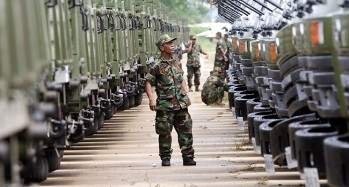
The Cambodian government has deployed extra troops and armored vehicles in the capital, Phnom Penh, because of the opposition’s warning it could take to the streets. The tough reputation of Hun Sen, who has ruled for 28 years, has raised concerns he might use force against protesters.
Navuth Koeut, the defense attache at Cambodia’s embassy in Washington, said he could not comment about any suspension in military cooperation programs as he has not received information from Phnom Penh about it.
US military assistance on maritime security, counterterrorism and humanitarian operations makes up a small portion of the more than $70 million in annual American aid to Cambodia but reflects Washington’s attempts to build bridges with a Southeast Asian government which counts China as its main benefactor.
Military cooperation has been on the uptick since 2006 and includes training for Cambodian officers and periodic military exercises. One of Hun Sen’s sons was trained at the US Military Academy.
Human Rights Watch has been pushing for the United States to sever military ties, arguing that Cambodia’s armed forces are corrupt, politicized and implicated in rights abuses.

Resource from:
BY MATTHEW PENNINGTON, THE ASSOCIATED PRESS

วันจันทร์ที่ 5 สิงหาคม พ.ศ. 2556

Japan : IMF calls for Japan reforms, plan to clear debt

Japan : IMF calls for Japan reforms, 
plan to clear debt


The International Monetary Fundsays Japan's economy is recovering from years of stagnation, but that far-reaching reforms and a ``credible plan'' are needed to reduce its debt mountain and sustain growth in the long run. 

The IMF's assessment, in a report issued Monday, says the near-term outlook of the world's third-largest economy ``has improved considerably'' thanks to monetary easing and increased government spending under the administration of Prime Minister Shinzo Abe


It forecasts that Japan's economy will grow 2 percent in 2013, helped by stronger demand at home and overseas, but will expand only 1.2 percent in 2014 as consumers tighten their belts following an expected increase in sales tax. 

The IMF's report, based on a consultation with the Abe government last month, echoes earlier comments by the World Bank's lending arm on the ``Abenomics'' strategy of breaking out of a long spell of debilitating deflation by flooding the economy with money. At Abe's behest, Japan's central bank is striving to generate 2 percent inflation within the next two years. 

But the report emphasized the need for ``significant adjustments'' to help reduce Japan's public debt, which will amount to nearly 250 percent of the country's gross domestic productthis year. 

``The growth outlook is subject to significant risks, primarily stemming from incomplete domestic reforms and a weaker external environment,'' the report said. It said a ``credible medium-term fiscal plan should be adopted as quickly as possible as fiscal risks have risen further.'' 

A central concern is a potential loss of confidence in Japan's ability to service its debt, given that repaying just the interest on government bonds is consuming a growing share of the country's limited tax revenues. Japan's parlous fiscal situation is compounded by surging health and welfare costs due to the fast-expanding share of elderly in the population. Rising inflation would inevitably push interest rates on government bonds higher, adding to the burden. 

Uncertainty over the resilience of the recovery has prompted debate in Tokyo over whether the government should follow through on its pledge to raise the sales tax from 5 percent to 8 percent by next April, and eventually doubling it to 10 percent by 2015. 

Unlike some other countries facing crushing levels of public debt, such as Greece and Cyprus, Japan's financial system remains generally sound, the report said. 

Most public debt is held by Japanese investors and financial institutions, helping to reduce the threat of a rapid and destabilizing exodus of cash. Japan's banks have relatively low levels of debt, while a rally in share prices since late last year has burnished their financial performances. 

Over the long run, Japan's economic growth will likely settle near about 1 percent, as government spending on reconstruction from the March 2011 tsunami disaster is wound down, taxes increase and the pool of employable workers ages and shrinks, it said. 


Resource form:
http://economictimes.indiatimes.com/news/international-business/imf-calls-for-japan-reforms-plan-to-clear-debt/articleshow/21627234.cms

วันพฤหัสบดีที่ 1 สิงหาคม พ.ศ. 2556

Indonesia :Tanker KM Patriot Andalan Spills 5,400 Tons Of Fuel Oil Into Molucca Sea

Indonesia : Tanker KM Patriot Andalan Spills 5,400 Tons Of Fuel Oil Into Molucca Sea

An oil tanker owned by Indonesia’s state oil and gas company, Pertamina, spilled around 5,400 tonnes of fuel into the Molucca Sea, the domestic media reported on Wednesday.
The KM Patriot Andalan was carrying 7,000 tonnes of fuel from Papua and was anchored at the port of Ternate in eastern Indonesia when high seas caused the tanker to hit the port and eventually sink.

“We are currently trying to contain the oil spill and prevent it from expanding further, while trying to neutralize the oil already spilled into the sea,” Pertamina fuel distribution manager Bagus Handoko, was quoted as saying by the Jakarta Globe newspaper.
Pertamina was not immediately available for comment.
Resource from:

วันพุธที่ 31 กรกฎาคม พ.ศ. 2556

World Economic : There’s a light at the end of the tunnel.

World Economic  : There’s a light at the end of the tunnel.


Better US economic growth,  earnings drive stocks 
Steady growth in the U.S. economy and higher company earnings are pushing the stock market higher in early trading.
The Dow Jones industrial average was up 45 points, or 0.3 percent, to 15,566 after the first few minutes of trading.
The Standard & Poor's 500 index was up four points, also 0.3 percent, to 1,690. The Nasdaq composite rose 16 points, or 0.5 percent, to 3,633.
Bond yields rose after the government reported that the U.S. economy grew at an annual rate of 1.7 percent in the second quarter, more than economists were expecting.
The yield on the 10-year Treasury note rose to 2.69 percent from 2.61 percent.
MasterCard rose 3 percent to $620.73 after reporting a 19 percent increase in second-quarter profit as more people worldwide used its cards.
Resource from:

 Eurozone jobless down for  first time in 2 years 
Further evidence emerged Wednesday that the eurozone economy is on the mend after struggling with a recession that's seen unemployment edge toward the 20 million mark.
Figures from Eurostat, the EU's statistics office, showed that the number of unemployed across the 17 European Union countries that use the euro fell by 24,000 in June to 19.27 million. That's the first fall since April 2011 and adds to the weight of recent evidence that suggests the recession in the eurozone has — or is about to — come to an end.
"While the latest data are far from suggesting a quick turnaround, the stabilization provides some relief from the relentless rise in the number of unemployed to date," said Timo del Carpio, European economist at RBC Capital Markets.
The eurozone's economy has been shrinking since the last quarter of 2011 as a raging debt crisis prompted many countries to pursue tough austerity policies that weighed on economic activity and confidence.
However, many analysts think figures next month will show the region may have eked out modest growth during the second quarter, thanks mainly to a rebound in Germany, Europe's biggest economy.
On top of that, other countries' output — even for those at the forefront of Europe's debt crisis — do not appear to be contracting on such a large scale as earlier on in the year.
That's partly due to a combination of the scale of spending cuts and tax increases in certain countries easing in the last few months and a calmer backdrop in financial markets. Another reduction in the European Central Bank's main interest rate to the record low of 0.5 percent has also helped to shore up economic activity.
Figures this week showed that the Spanish recession nearly ended in the second quarter while there are hopes that even Greece — the epicenter of the region's debt woes — may start growing again at the end of this year following a recession that's wiped out around a fifth of the country's output.
Since unemployment started rising again over two years ago, nearly 4 million people have lost their jobs in the eurozone and that's lifted the overall unemployment rate to 12.1 percent from around the 10 percent mark. That provides a stark contrast to the U.S., where the jobless rate has steadily fallen to 7.6 percent.
One of the most damaging effects of the eurozone's return to recession has been an inexorable rise in unemployment particularly of the young. In June, 3.53 million people aged under 25 were unemployed in the eurozone. The unemployment rate among the region's young rose slightly between May and June from 23.8 percent to 23.9 percent.
"A situation in which almost a quarter of young people who are available for work cannot find a job is storing up significant social and economic problems for the future," said Andrea Broughton, Principal Research Fellow at the Institute for Employment Studies.
Overall, the eurozone's unemployment rate was also lower than expected — though at a record high. At 12.1 percent in June, it's unchanged on the previous month following a downward revision to May's original 12.2 percent estimate.
Wednesday's figures are only one month but they do provide some hope that there is now light at the end of the tunnel. In Spain, for example, the number of unemployed fell to 5.96 million from the previous month's 6 million and that pulled the jobless rate down to 26.3 percent from 26.4 percent.
Despite that moderately encouraging signal, Spain's youth unemployment rate rose again in June to 56.1 percent from the previous month's 55.8 percent. The situation in Greece is even worse, with 58.7 percent of under 25s out of work in April, up from the previous months' 58.5 percent — Greece's figures are compiled on a different timeframe. In April, Greece's overall unemployment rate stood at 26.9 percent, just up on the previous month's 26.8 percent.
Wednesday's figures once again highlighted the huge disparities across the eurozone with some countries, such as Austria and Germany operating near what economists term full employment — the level where those seeking work more or less corresponds to those employed.
Separately, Eurostat reported that consumer price inflation in the eurozone was unchanged at 1.6 percent in the year to July, in line with expectations.
Though inflation remains below the European Central Bank's target of keeping annual price rises just below 2 percent, rate-setters are expected to keep the bank's main interest rate unchanged at 0.5 percent following the conclusion of their monthly policy meeting on Thursday.
"Signs that the euro area is emerging from recession and accelerated inflation have eased pressure on the ECB to cut rates," said Tomas Holinka, economist at Moody's Analytics.
Resource from:

วันอาทิตย์ที่ 28 กรกฎาคม พ.ศ. 2556

Cambodia : The battleground seats

Cambodia : The battleground seats


Siem Reap
6 seats
Though Siem Reap has long been a ruling-party stronghold (the CPP won four of six seats here in 2003, increasing their spoils to five of six seats in 2008), if recent opposition rallies are anything to go by, the province could be one of the more competitive domains in this election.
An estimated 100,000 supporters turned out to greet Sam Rainsy there Wednesday, possibly matching the number that turned out in Phnom Penh, the party’s traditional base, for his return from self-exile.
Rainsy’s rhetoric in Siem Reap aimed to exploit local sentiments that “Vietnamese” businesses have too much control over the province’s lucrative tourist trade.
Analysts also say that living standards in Siem Reap, which remains one of the Kingdom’s poorest provinces, will be a key issue.

Kampong Speu
6 seats
Despite being a relatively small province and one dominated by the CPP at the last national election, observers point to Kampong Speu as an area where competition between the two main parties will heat up in this election.
The now-merged SRP and HRP together won 34 per cent of total votes in last year’s commune elections, to the CPP’s 56 per cent, up from the 28 per cent of votes won between them in the 2008 national election.
In those same commune elections, parties other than the CPP were able to win 33 per cent of seats.
Old rivalries will also come to a head in Kampong Speu, with Pen Sovann, Cambodia’s first prime minister after the Khmer Rouge and a historic rival of Hun Sen, placed first on the CNRP ballot.
Hun Many, the premier’s youngest son and the first to run for office, is listed as a CPP candidate.
A successful election for him would signal the first step towards a new generation of CPP leadership.
Phnom Penh
12 seats
The Kingdom’s capital, worth a sizeable 12 seats, will always be an electoral battleground. In 2003, half the seats were won by the SRP, with the CPP and Funcinpec taking four and two seats respectively.
With Funcinpec’s 2008 electoral wipeout, the CPP took seven seats to the SRP’s five in 2008.
This election, observers are tipping the major parties to be in a dead heat for Phnom Penh, though some say the CNRP might have a slight edge.
Party heavyweights will also face-off in the capital, with CPP chairman/Senate president Chea Sim and former Phnom Penh governor Kep Chuktema running for the ruling party, while influential lawmaker Son Chhay and party spokesman Yim Sovann are on the CNRP ballot.

Kampong Cham
18 seats
The most populous province, with a mammoth 18 seats on offer, and home to many of the Kingdom’s sizeable Muslim Cham minority, Kampong Cham was one of the most contested provinces in the 2012 commune elections (where non-ruling parties managed to win 40 per cent of the total available seats).
The CPP won 11 seats here in 2008, but analysts expect the opposition to make further inroads this election. In a sign of the province’s clout, CNRP deputy president Kem Sokha and National Assembly president/CPP honorary chairman Heng Samrin are both running here as candidates, as is Foreign Minister Hor Namhong.
Funcinpec’s president, Princess Norodom Arun Rasmey, is also running in Kampong Cham and hopes to retain the seat won in 2008 by a fellow royalist from the now-defunct Norodom Ranariddh Party (with which Funcinpec recently merged).

Prey Veng
11 seats
Although the CPP picked up seven of the 11 seats available in Prey Veng in 2008 on the back of Funcinpec’s decline, the province was the most contested in the 2012 commune elections.
In last year’s election, the HRP and SRP polled a total of 210,209 votes to the CPP’s 258,716 votes. Now that the opposition parties have merged into the CNRP, Prey Veng could shape up for a major showdown.
Given that the province is located on the border with Vietnam, observers say the CNRP’s anti-Vietnamese rhetoric will appeal to Prey Veng voters.

Kandal
11 seats
With 11 seats on offer, Kandal province, home to Prime Minister Hun Sen’s National Assembly seat, has been labelled by some observers as “the province to watch” this election.
In 2008, the SRP held on to three seats in the province. Its current CNRP alliance partner, the HRP, also picked up a seat amid the Funcinpec implosion that saw the royalists lose all three of their seats in the province.
The opposition will be hoping to claw back some of the CPP’s seven seats in Kandal come Sunday, but with Hun Sen’s reputation on the line, the ruling party is likely to do all it can to remain dominant.

Resource from:
http://www.phnompenhpost.com/national/battleground-seats

Cambodia : Cambodians go to polls as PM Hun Sen seeks to extend grip on power

Cambodia : Cambodians go to polls as
 PM Hun Sen seeks to extend grip on power
The former Khmer Rouge fighter turned prime minister appears so confident of victory that he did not even bother to personally campaign for the parliamentary election.
Galvanised by the return from exile of their leader Sam Rainsy, his political foes have injected some rare competition into the race.
But the opposition has also decried signs of voter fraud and warned a Hun Sen win will be "worthless" without Mr Rainsy's participation.
The French-educated former banker returned to Cambodia on July 19 from self-imposed exile after receiving a surprise royal pardon for criminal convictions which he contends were politically motivated.
But he is barred from running as a candidate since the authorities said it was too late to add his name to the electoral register.
"If the prime minister wants to keep his position he must be brave enough to confront me," Mr Rainsy said on the eve of the vote.
"It's very unfair and shows that the current prime minister is really a coward," he added.
His Cambodian National Rescue Party (CNRP) says many names have disappeared from the electoral roll while thousands of people could not vote as someone else had already used their ballot.
Party spokesman said Yim Sovann the ink used for voting was also easily washed off.
"The situation is more serious than at any previous election," he said.

Ruling party confident of landslide

New York-based Human Rights Watch has warned the vote will be anything but free and fair, highlighting alleged manipulation of voter rolls and campaigning by senior security forces officers for the ruling Cambodian People's Party (CPP).
"The process has been manipulated to ensure victory for the ruling party," said HRW Asia director Brad Adams.
While the government denies the allegations, CPP spokesman Khieu Kanharith said the party was confident of another landslide.
"We expect to keep an absolute majority," he said.
About 9.6 million people are registered to vote - more than one-third of whom are below the age of 30.
Hun Sen oversaw Cambodia's transformation from a nation devastated by the Killing Fields genocide era to become one of Southeast Asia's most vibrant economies.
The 60-year-old premier - who has vowed to rule until he is 74 - is regularly accused of trampling on human rights and quashing political dissent.
And while garment exports and tourism have brought double-digit economic growth, Cambodia remains one of the world's poorest countries.
Resource from:

วันศุกร์ที่ 26 กรกฎาคม พ.ศ. 2556

Cambodia : Sam Rainsy’s request for immunity rejected

Cambodia : Sam Rainsy’s request 
for immunity rejected
Opposition leader Sam Rainsy’s request to have his parliamentary immunity restored before Sunday’s national election was refused yesterday by the National Assembly permanent committee — which consists wholly of ruling Cambodian People’s Party lawmakers.


“The permanent committee has unanimously decided that because [Rainsy] has become a president of [Cambodia] National Rescue Party — which does not have seats in … parliament — that it cannot restore … immunity,” National Assembly president Heng Samrin wrote in a letter to Rainsy.
The granting of Rainsy’s request could have allowed the pardoned leader to make one final bid to be registered as a candidate.
In June, the same committee stripped opposition lawmakers of their political status, claiming they had broken the law by joining the CNRP after winning their seats as Sam Rainsy Party and Human Rights Party members. Those two parties merged to become the CNRP last year.
Rainsy wrote to Samrin on Tuesday, asking for his immunity to be restored, citing a law that states that “any lawmaker convicted and granted a pardon from the King will have his immunity restored”.
On Monday, the National Election Committee ruled that Rainsy’s name will remain off its lists, meaning he is ineligible to run as a candidate or vote.
Nguon Nhel, first deputy of the National Assembly, said Rainsy had forfeited his immunity by resigning from the SRP.
Rainsy not being allowed stand as a candidate would not affect the legitimacy of the election and observers would still recognise the result, he added.
CNRP spokesman Yim Sovann disagreed.
“An opposition party president who does not have his name in the voter list and cannot stand as a candidate — how is this election free and just?” he said.
Koul Panha, executive director of election monitor Comfrel, said the committee’s refusal to restore Rainsy’s immunity was contrary to constitutional law.
“The [parliamentary] law contradicts constitutional law. [Constitutionally], refusing to restore [Rainsy’s immunity] is not legal,” he said.

Resource from:
0

Comments

Please, login